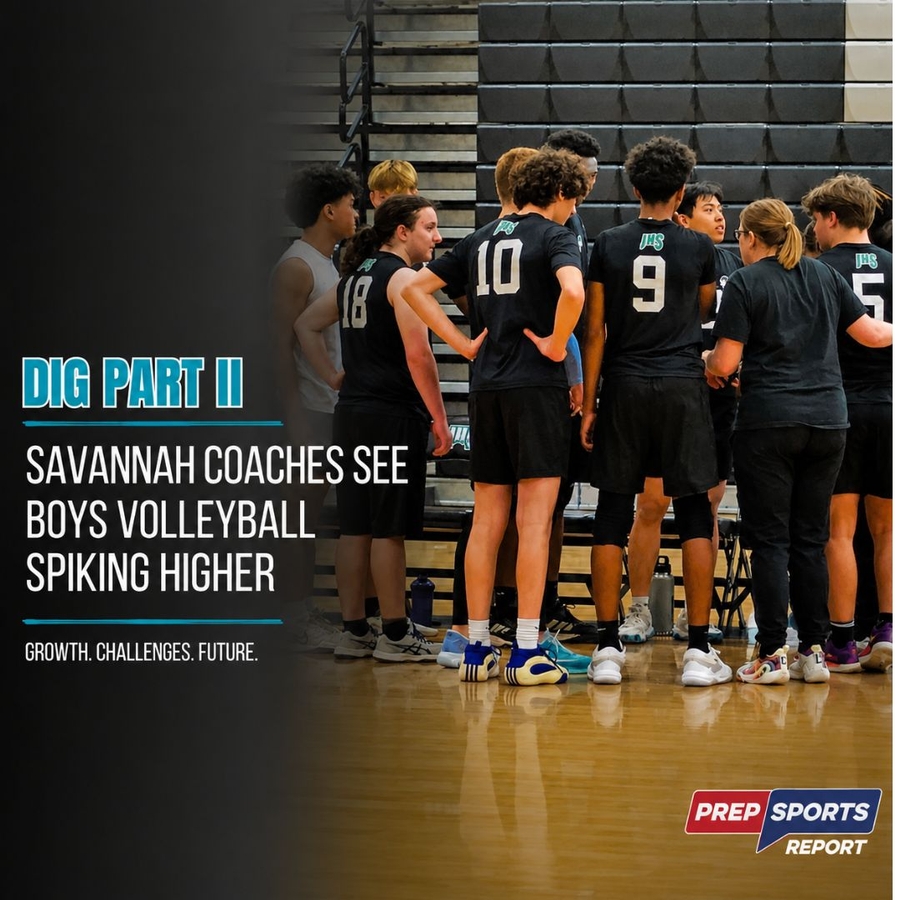
Local boys' volleyball programs continue to grow across the Savannah area as coaches work to build interest in a sport many believe could someday become GHSA-sanctioned.
Prep Sports Report asked local coaches about the growth of the game, the challenges of teaching new players, and how athletes have responded to the sport.
What attracts boys to playing the sport?
Coastal Velocity coach Samantha Krick:
“I would say it’s just fun. My guys who are basketball players, I see how hard they work. I see how serious their practices are. They’re playing basketball for five, six months out of the year, 30 games in the season. It’s intense. You don’t see a lot of smiles. I know my guys. I’ve watched them play. I’ve watched them practice in several different sports. When they come out on the volleyball court, we play our best matches when they’re acting silly, when they’re doing their little TikTok dances or whatever. When they have fun and relax, it just becomes a fun sport and they play their best. I think they like the challenge, but I think they like that it’s just fun.”
Woodville-Tompkins coach Kacey Matthews:
“They could be at the net. They could jump. They could try and block balls, somewhat of an aspect of basketball. Also hitting, spiking the ball, was another enticing part.”
Savannah Classical coach Nick Lavery:
“(Spiking on an opponent) – totally; a block, the same way. That’s one of my biggest selling points. I tell the other coaches. ‘You’ve just got to tell them every play is like an alley-oop (dunk). You’re trying to throw an alley-oop every single play, and you’re trying to block an alley-oop every single play.”
Islands coach Jessica Decker:
“Some of them have said, if their primary sport is football or basketball, it helps them with hand-eye coordination and working on their vertical, and so just using it as a way to facilitate or to better them in their other sports. In general, word’s just gotten around. They love playing it in PE. It’s become destigmatized at Islands. I know at first I was fighting an uphill battle, everybody thought, ‘Oh, volleyball’s a girls sport.’ But I had some relatively, you could say, influential players over the last couple of years who were like big football, basketball players who came out and played. That helped destigmatize the program. Now we’re not fighting that battle like (when) we started four years ago.”
What’s been the reaction at school?
Woodville-Tompkins’ Matthews:
“I think it was accepted (by boys) really well. We’ve had some good support from their peers when we’ve had games here and games away -- from peers, from parents that have been very supportive. I think it was just getting people to watch a game. I think some people might have a preconceived notion that volleyball is a girls sport, not really understanding the actual skills and what it takes to play volleyball.”
What’s the hardest aspect of the sport for players to pick up?
Savannah Classical’s Lavery:
“I would say, technique-wise, it's passing, platform passing (and) in particular, serve receive. When that ball’s coming from 45 feet away, you put your arms out, and there’s shanks galore when it starts out. Definitely, serve and receive is one of the hardest skills to get.
“As far as volleyball IQ, the angles, that’s definitely a big learning curve. Where to be? Whose zone? Whose ball is it supposed to be? The communication side because most of them have never watched volleyball.”
Islands’ Decker:
“They just want to go after everything so hard all the time. (They should be) more tactical. At least with my (girls) program, I haven’t had a ton of height or power, but we focus a lot on the tactical aspect: where to tip the ball, how to read the defense, where a good roll shot will be. It’s not all about power. The boys want power all the time (instead of) working the finer aspects of things.”
Woodville-Tompkins’ Matthews:
“I think the hardest aspect of volleyball is passing. We can sit here and do little rainbow tosses, it’s easy to pass. But when somebody is hitting or spiking a ball at you and you have to be able to control it, that’s hard.”
How do the boys like it when girls, usually their school peers, are coaching them at practice?
Islands’ Decker:
“They take it exceptionally well. I’ve got a handful of my current and graduating players that come and help. (The boys) definitely respect what they have to say. For the most part, they treat them the way they would treat me with the same level of respect. I think the boys, obviously, know that the girls that are there helping know what they’re talking about or else I wouldn’t have them there. They show them a lot of respect in that regard and ask for help. It’s a really cool thing to see.”
Woodville-Tompkins’ Matthews:
“I had so many kids that wanted to come out and be a manager, come out and coach, as far as my players. I’ve had a set group of girls come out. It’s just me out here and there are so many aspects of the game that (the boys) just didn’t know. I would take my girl setters and ask them to work with my boy setters in teaching them things. For the most part, they’ve accepted it pretty well. There are times they don’t want to be told what to do by girl or by a peer. I made it clear to them that they’re here for both sides. They’re here to help each other. I think it’s gotten my girls a little better as well.”
Coastal Velocity’s Krick:
“You’d think a bunch of high school boys would be put off by having a young adult (college student and former high school volleyball player CJ Jungeburg) come in and kind of boss them around on the court. But they realize how much she knows and how much they lack, that they are really good about listening to her. What she says is helping them improve.”
What do you see happening in the future?
Savannah Classical’s Lavery:
“I think when it gets sanctioned, overnight (teams) are going to pop up everywhere. … When it gets sanctioned, they’ll throw out those interest meetings, emails and messaging. The boys are going to show up because, one, it’s super fun. … ‘Oh, volleyball’s actually a pretty cool sport. It’s not a girls sport.’ I think that stigma’s going to get broken quick. It’s one of the fastest-growing sports in the country, volleyball, and then boys' volleyball in particular.”
Islands’ Decker:
“I think in our area, we’ve got a handful of other schools that are right there on the cusp. Jenkins and Savannah High have shown interest in the past. … I think it’s definitely on the way up. It’s just going to take a while to get sanctioned.”
Coastal Velocity’s Krick:
“We are trying to focus on almost the younger crowd (such as the middle school team) because boys' volleyball is not played here, like it is in other places, and a lot of our guys are already committed to other sports.
“If we can reach a younger generation and start with our middle school program and build that up, I think we’ll see volleyball really explode here in the next few years. That’s my dream at least.”
Photo by Islands High School Volleyball Program
Follow Prep Sports Report on X @PrepSav and Instagram @savannahsportsreport.
To share scores, story ideas, or corrections, email kdemasi@prepsportsreport.com or text 912-507-9158.