SAVANNAH, Ga. — The moment does not always look dramatic.
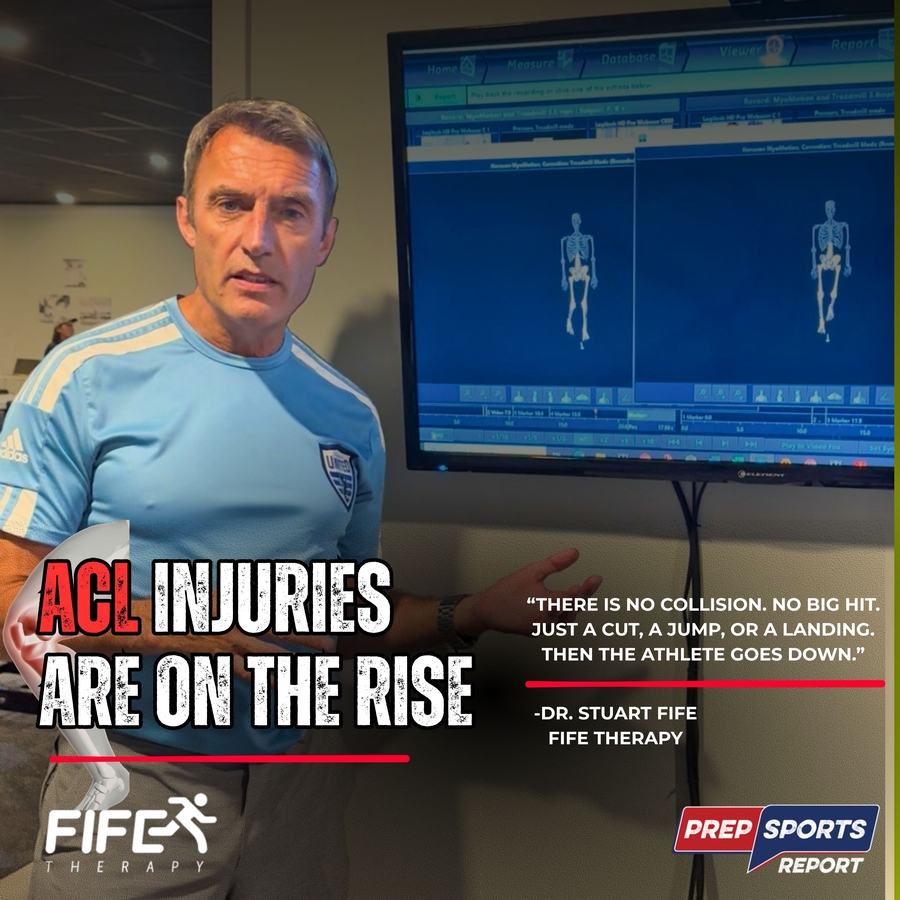
There is no collision. No big hit. Just a cut, a jump, or a landing. Then the athlete goes down.
The Coach sat down with Dr. Stuart Fife of Fife Therapy to discuss ACL injuries live on the Savannah Sports Report April 22, 2026, sharing insight on why these injuries are increasing and how athletes can reduce their risk.
Across youth and high school sports, anterior cruciate ligament injuries, better known as ACL tears, are becoming more common, and the impact can extend far beyond a single season.
“In general, it’s on the rise,” said Dr. Stuart Fife, owner of Fife Therapy in Savannah. “We’ve got a lot more knee injuries than we ever have.”
The trend is showing up across sports, from soccer and basketball to volleyball and softball. According to Fife, female athletes are particularly at risk.
“Females are about six times more likely than boys in high school soccer,” Fife said. “And not all players get back to the level they were. About 40 percent don’t.”
Recovery is often long and demanding. Fife said many athletes take up to two years to return to full performance, a timeline that can disrupt development and, in some cases, scholarship opportunities.
For some athletes, it means missing a senior season. For others, it can change a college opportunity.
Unlike many sports injuries, ACL tears often occur without contact.
“Most of these injuries are non-contact,” Fife stated. “When you land or cut, the knee is very vulnerable.”
When those muscles, particularly the hamstrings, are not strong enough to stabilize the joint, the stress shifts to the ligament.
“The hamstring is a synergy to the ACL,” Fife pointed out. “If it’s not strong enough, the risk goes up.”
While the numbers are concerning, Fife stressed there is a proven path forward.
One of the most effective tools is the FIFA 11+ injury prevention program, a structured warmup routine designed to improve strength, balance, and movement control.
“They reduced the ACL injuries by two thirds,” Fife said. “It’s just two or three times a week, about 20 minutes.”
Fife pointed to data from international soccer showing widespread adoption of the program led to a significant drop in injuries among female athletes.
“If you can do it in soccer you can do it in volleyball, softball, basketball,” he said.
Parents and coaches can access The FIFA 11+ injury prevention program here:
The FIFA 11+ Injury Prevention Program
Despite the results, implementation at the high school level remains inconsistent.
“We spend a lot of time warming up,” Fife said. “We just need to modify how we warm up.”
Another contributing factor is the growing trend of athletes specializing in a single sport at a young age.
According to Fife, that approach can limit overall athletic development.
“Athletes who specialize in one sport have about 40 percent more injuries,” he said. “When you play multiple sports, the body learns how to handle different movements.”
In contrast, repetitive movement patterns without variation can increase stress on the same joints and muscles over time.
Fife said one of the most overlooked aspects of injury prevention is proper evaluation.
“You have to test and understand this,” he said. “Are they strong enough or not.”
Strength imbalances, particularly between muscle groups or between sides of the body, can increase injury risk even in athletes who appear well-conditioned.
“You can’t just look at the numbers,” Fife said. “You have to look at the normative data.”
For athletes returning from injury, the stakes are even higher.
“The biggest predictor of an injury is a previous injury,” Fife said. “If it’s not fully rehabbed, you’re at risk again.”
He added that relying on how an athlete feels is no longer enough.
“Those days are gone,” Fife said. “You have to test and understand where they are.”
Fife believes the solution is not complicated, but it requires commitment from coaches, parents, and athletes.
“We don’t need to reinvent the wheel,” he said. “The information is already there.”
With more athletes competing year-round and at higher levels, the focus on prevention is becoming increasingly important.
“We can significantly reduce the risk if we do the right things,” Fife said.
The difference between staying on the field and sitting on the sideline might come down to what you do before practice even starts.
For more information or to schedule testing, athletes and parents can contact Fife Therapy, located at 6 Mall Terrace in Savannah. Call (912) 239-6140 or visit https://fifetherapy.com/ to learn more about injury prevention programs and performance evaluations.
Photo Credit:
Follow Prep Sports Report on X @PrepSav and Instagram @savannahsportsreport.
To share scores, stories, or corrections, email kdemasi@prepsportsreport.com or text 912-507-9158.
Prep Sports Report — Celebrating Local Athletes Since 2000